
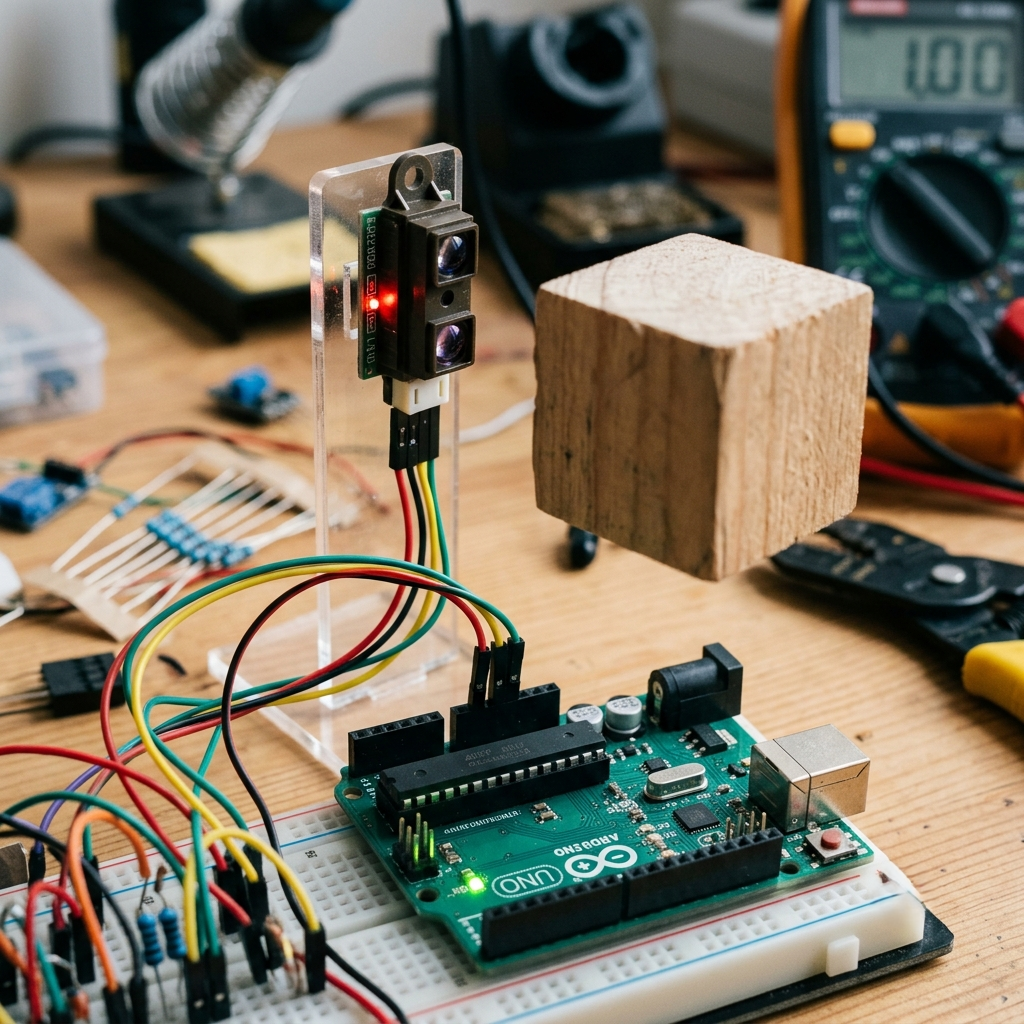
Infrared (IR) sensors are among the most widely used electronic sensors in today’s world. From TV remote controls and automatic doors to robots and security systems, these small devices play an important role in detecting objects, measuring distance, and sensing movement.
If you’ve ever wondered how do IR sensors work, you’re not alone. Understanding their working principle is easier than it might seem. IR sensors use invisible infrared light to detect objects or changes in their surroundings, making them valuable in countless consumer, industrial, and automation applications.
In this guide, you’ll learn how IR sensors work, the different types available, their components, advantages, limitations, and where they are commonly used.
What Is an IR Sensor?
An Infrared (IR) sensor is an electronic device that detects infrared radiation. Infrared light is part of the electromagnetic spectrum, with wavelengths longer than visible light but shorter than microwaves. Although humans cannot see infrared light, many electronic devices can generate and detect it.
IR sensors are designed to detect:
- Objects
- Movement
- Heat
- Distance
- Position
- Presence of nearby items
Because they operate without physical contact, IR sensors are ideal for applications that require fast and reliable detection.
How Do IR Sensors Work?
The answer to how do IR sensors work depends on the type of sensor being used, but the basic principle is simple.
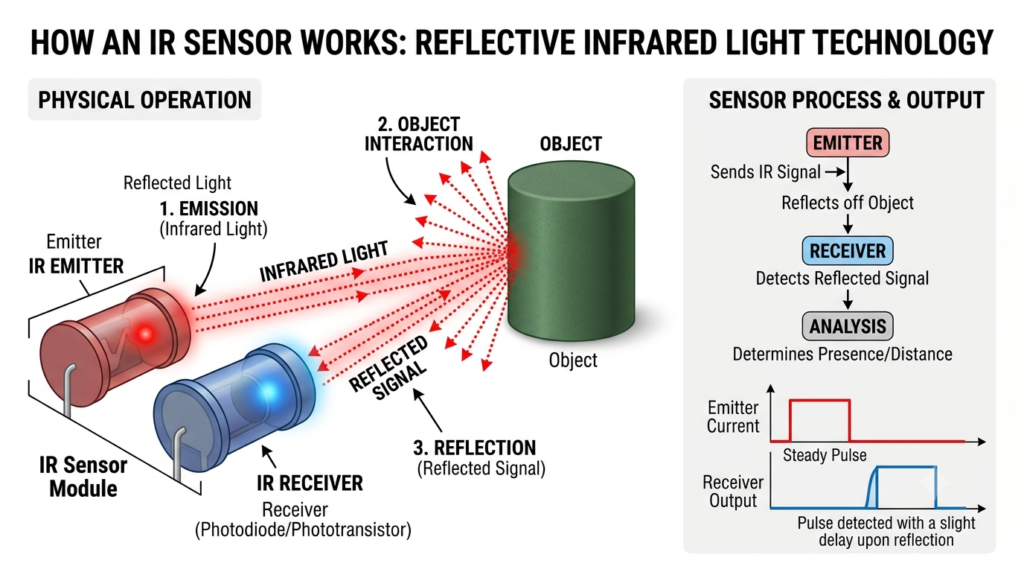
An IR sensor works by using infrared radiation. Some sensors emit infrared light and detect its reflection, while others detect naturally emitted infrared energy from warm objects.
The process generally follows these steps:
- An infrared emitter produces IR light (for active sensors).
- The light travels toward an object.
- The object reflects part of the infrared light.
- An IR receiver detects the reflected light.
- The sensor converts the received signal into an electrical signal.
- A microcontroller or electronic circuit processes the signal and performs an action.
For passive IR sensors, the sensor simply detects heat energy emitted by people, animals, or other warm objects without sending out infrared light.
Main Components of an IR Sensor
Most IR sensors contain several essential components.
IR Emitter
The emitter is usually an infrared LED.
Its job is to produce infrared light that travels toward nearby objects.
Unlike ordinary LEDs, infrared LEDs emit light that is invisible to the human eye.
IR Receiver
The receiver detects reflected infrared light.
Common receiver types include:
- Photodiodes
- Phototransistors
- IR detectors
When infrared light reaches the receiver, it generates an electrical signal that can be measured.
Signal Processing Circuit
The electrical signal produced by the receiver is usually very small.
A signal processing circuit amplifies and filters the signal before sending it to a controller or processor.
Output Interface
Finally, the processed signal is delivered to another electronic device such as:
- Arduino
- Raspberry Pi
- PLC
- Robot controller
- Alarm system
- Automation controller
The connected device decides what action should be taken based on the sensor’s output.
Types of IR Sensors
There are two primary types of infrared sensors.
Active IR Sensors
Active IR sensors contain both:
- Infrared transmitter
- Infrared receiver
The transmitter continuously emits infrared light.
When an object comes within range, the light reflects back toward the receiver.
The amount of reflected light helps determine whether an object is present.
These sensors are commonly used for:
- Obstacle detection
- Distance sensing
- Line-following robots
- Automatic doors
- Industrial automation
Passive IR Sensors (PIR)
Passive Infrared Sensors, commonly called PIR sensors, work differently.
Instead of transmitting infrared light, they simply detect heat emitted naturally by surrounding objects.
Humans and animals constantly emit infrared radiation because of body heat.
When a warm object moves within the sensor’s detection area, the PIR sensor detects the change and generates an electrical signal.
PIR sensors are commonly used in:
- Motion detectors
- Security systems
- Smart lighting
- Home automation
- Occupancy sensors
Understanding Reflection-Based Detection
Many object detection sensors use reflected infrared light.
Here’s a simple example.
Imagine placing an IR sensor in front of a wall.
The IR emitter sends invisible infrared light toward the wall.
The wall reflects some of that light.
The receiver detects the reflected light.
The electronic circuit determines that an object is present.
If the wall is removed, much less infrared light returns to the receiver, and the sensor detects no object.
This simple principle powers countless automation systems.
Detection Distance
The detection range depends on several factors, including:
- Sensor design
- Emitter power
- Receiver sensitivity
- Object color
- Surface material
- Ambient lighting
- Viewing angle
Bright, reflective objects usually return more infrared light than dark or rough surfaces.
Because of this, detection distance can vary even when using the same sensor.
Advantages of IR Sensors
Infrared sensors have become popular because they offer many practical benefits.
Low Cost
IR sensors are relatively inexpensive compared to many other sensing technologies.
This makes them suitable for educational projects, consumer electronics, and industrial equipment.
Fast Response
Infrared detection occurs almost instantly.
This makes IR sensors ideal for applications requiring quick responses.
Low Power Consumption
Many IR sensors require very little electrical power.
Battery-powered devices often use IR sensors because of their energy efficiency.
Compact Size
Most infrared sensors are small enough to fit inside compact electronic products.
Examples include:
- Remote controls
- Mobile robots
- Smart home devices
- Consumer electronics
Easy Integration
IR sensors can easily connect to:
- Arduino boards
- Raspberry Pi
- ESP32
- Microcontrollers
- PLC systems
This makes them popular among students, hobbyists, and professional engineers.
Limitations of IR Sensors
Although IR sensors are useful, they also have certain limitations.
Limited Range
Most standard IR sensors only detect objects over short distances.
Applications requiring long-range detection may use radar, ultrasonic sensors, or LiDAR instead.
Sensitive to Environmental Conditions
Bright sunlight contains infrared radiation.
Strong ambient light can sometimes interfere with sensor performance.
Surface Dependence
Dark-colored objects often reflect less infrared light.
As a result, detection accuracy may vary depending on the object’s material and color.
Cannot See Through Solid Objects
Infrared light cannot pass through walls or most solid materials.
Objects hidden behind obstacles cannot be detected.
Common Applications of IR Sensors
Infrared sensors are found in many industries and everyday products.
Some common examples include:
Consumer Electronics
- TV remote controls
- Air conditioner remotes
- Smart appliances
Robotics
Robots use IR sensors for:
- Obstacle avoidance
- Line following
- Distance detection
- Navigation
Home Automation
Smart homes often use PIR sensors for:
- Motion detection
- Automatic lighting
- Energy-saving systems
- Security monitoring
Industrial Automation
Factories use IR sensors to:
- Detect products on conveyor belts
- Count manufactured items
- Position machinery
- Improve production efficiency
IR Sensors vs PIR Sensors
Many people think IR sensors and PIR sensors are the same, but they are designed for different purposes.
IR Sensor
- Can emit infrared light.
- Detects reflected infrared light.
- Used for obstacle detection, object sensing, and distance measurement.
PIR Sensor
- Does not emit infrared light.
- Detects heat naturally emitted by people and animals.
- Mainly used for motion detection.
Understanding this difference helps you choose the right sensor for your project.
Real-World Applications of IR Sensors
Infrared sensors are used in many industries because they are reliable, affordable, and easy to integrate.
Robotics
Robots use IR sensors to:
- Avoid obstacles
- Follow black or white lines
- Detect nearby objects
- Navigate indoor environments
Educational robotics kits often include IR sensors because they are simple to program.
Smart Homes
Modern homes use PIR sensors for:
- Motion-activated lighting
- Smart security systems
- Occupancy detection
- Automatic energy-saving controls
For example, hallway lights may turn on automatically when someone walks past the sensor.
Automotive Industry
Vehicles use infrared technology in applications such as:
- Driver monitoring systems
- Night vision assistance
- Occupancy detection
- Cabin monitoring
Some advanced vehicles also combine infrared sensors with cameras and radar to improve safety.
Healthcare Equipment
IR sensors are commonly found in medical and healthcare devices, including:
- Non-contact thermometers
- Patient monitoring systems
- Medical imaging equipment
- Temperature screening devices
Because infrared sensors can measure heat without touching the body, they are useful in hospitals and clinics.
Industrial Automation
Factories rely on IR sensors to automate production processes.
Common applications include:
- Detecting products on conveyor belts
- Counting packaged items
- Monitoring machine positions
- Object sorting systems
These sensors improve production speed while reducing manual work.
Consumer Electronics
Many everyday devices use infrared technology.
Examples include:
- Television remote controls
- Air conditioner remotes
- Smart speakers
- Gaming systems
- Automatic hand sanitizers
- Touch-free dispensers
Although users rarely notice them, IR sensors make these devices more convenient to use.
Tips for Choosing the Right IR Sensor
Selecting the right sensor depends on your application.
Consider these factors before purchasing one.
Detection Range
Choose a sensor with enough range for your project.
Short-range sensors work well for robots, while longer-range models may be needed for industrial automation.
Indoor or Outdoor Use
Outdoor environments contain sunlight, which can interfere with infrared signals.
If your project will operate outdoors, choose a sensor designed to handle ambient light.
Object Type
Some objects reflect infrared light better than others.
If your application involves dark, transparent, or highly reflective surfaces, test the sensor before deployment.
Power Requirements
Battery-powered devices benefit from sensors with low power consumption.
Always verify the operating voltage and current requirements.
Interface Compatibility
Ensure the sensor is compatible with your hardware platform, such as:
- Arduino
- Raspberry Pi
- ESP32
- STM32
- PLC controllers
- Industrial automation systems
Common Troubleshooting Tips
If your IR sensor isn’t working correctly, check the following:
- Clean the sensor lens.
- Verify the power supply.
- Confirm correct wiring.
- Reduce interference from bright sunlight.
- Adjust the detection distance.
- Check software settings.
- Test with different object materials.
Many detection issues can be resolved by improving sensor placement or reducing environmental interference.
Future of IR Sensor Technology
Infrared sensing continues to evolve as technology advances.
Modern IR sensors are becoming:
- More energy efficient
- More accurate
- Smaller in size
- Faster at processing signals
- Easier to integrate with IoT devices
As smart homes, robotics, automation, and artificial intelligence continue to grow, IR sensors are expected to remain an important part of modern electronic systems.
Internal Linking Opportunities
If your website covers electronics or technology, consider linking this article to related guides using descriptive anchor text such as:
- What Is an Ultrasonic Sensor and How Does It Work?
- Beginner’s Guide to Arduino Sensors
- Types of Electronic Sensors Explained
- How Motion Sensors Improve Smart Homes
- Best Sensors for Robotics Projects
- Introduction to IoT Devices and Smart Automation
These internal links help readers explore related topics while improving website navigation.
Conclusion
Understanding how do IR sensors work is essential for anyone interested in electronics, robotics, automation, or smart technology. These sensors detect infrared radiation to identify objects, movement, or heat without physical contact. Active IR sensors emit infrared light and detect its reflection, while passive infrared (PIR) sensors detect heat naturally emitted by people and animals.
Thanks to their affordability, low power consumption, fast response, and simple integration, IR sensors are used in everything from TV remote controls and robots to industrial automation and smart home security systems. By choosing the right type of IR sensor for your application and understanding its strengths and limitations, you can build more efficient and reliable electronic projects.
FAQ
1. How do IR sensors work?
IR sensors work by detecting infrared radiation. Active IR sensors emit infrared light and detect its reflection from nearby objects, while passive IR sensors detect heat naturally emitted by living beings or warm objects.
2. What is the difference between an IR sensor and a PIR sensor?
An IR sensor usually emits infrared light to detect nearby objects. A PIR sensor does not emit light; it detects changes in infrared heat, making it ideal for motion detection.
3. Where are IR sensors commonly used?
IR sensors are used in TV remote controls, robotics, automatic doors, industrial automation, security systems, smart homes, non-contact thermometers, and obstacle detection systems.
4. Can IR sensors work in sunlight?
Yes, but strong sunlight contains infrared radiation that may reduce accuracy or interfere with some IR sensors. Outdoor models are designed to minimize this issue.
5. Are IR sensors better than ultrasonic sensors?
It depends on the application. IR sensors are excellent for fast, short-range detection, while ultrasonic sensors are generally better for measuring longer distances and are less affected by object color.